After the April-July fiscal deficit data was released on August 31, several analysts hinted that the government may need to go for cuts in capital expenditure to meet the fiscal deficit target.
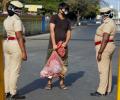
He also announced an assistance of Rs 3,000 for accredited journalists while acknowledging their role in the dissemination of information on COVID19.

However, economic growth in five years of the UPA and NDA cannot be compared because of the now complex back series data, reports Indivjal Dhasmana.

The government on Friday proposed hiking the securities transaction tax on Futures & Options (F&O) contracts, a move that will increase the trading costs in the derivatives segment as well as help in curbing excessive trades. In the Finance Bill 2023, passed by the Lok Sabha on Friday, the Securities Transaction Tax (STT) on options is proposed to be increased to 0.0625 per cent from 0.05 per cent and on futures contracts to 0.0125 from 0.01 per cent. Analysts opined that higher STT will shore up the government's revenues to some extent and also discourage excessive trading since a large number of retail traders are losing money in the segment.

Eyeing a windfall of close to Rs 50,000 crore, the Board of Control for Cricket in India on Tuesday floated the media rights tender for the next five seasons of IPL from 2023 to 2027.

The government is mulling changes in the income tax laws to bring cryptocurrencies under the tax net, with some changes that could form part of the Budget next year, a top official said. Revenue secretary Tarun Bajaj said that in terms of income tax, some people are already paying capital gains tax on the income from cryptocurrency, and in respect of Goods and Services Tax (GST) also the law is "very clear" that the rate would be applicable as those in case of other services.
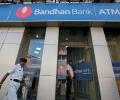
Bandhan Bank said on Monday that it has been empanelled by the Reserve Bank of India (RBI) to act as an agency bank to facilitate transactions related to government businesses. The RBI's decision will help Bandhan Bank in contributing to nation-building, its MD and CEO Chandra Sekhar Ghosh said. The announcement comes months after a RBI guideline that authorised scheduled private sector banks as agency banks of the regulator for the conduct of government business.

India's gross tax collections soared to a record high of Rs 27.07 lakh crore in the fiscal year ended March 31, led by impressive growth in corporate tax and customs, taking the tax-to-GDP ratio to an over two-decade high of 11.7 per cent, Revenue Secretary Tarun Bajaj said on Friday.

The challenge before the government now is to use the factors that are favourable to its benefit.

The government will have to make substantial payments, as well as forego revenues in FY'23, if it wants to work on the survival of Vodafone Idea because it will have to extend the same incentives to the entire telecom sector. According to estimates, the industry has to spend around Rs 21,000-Rs 25,000 crore for spectrum which it bought on a deferred payment basis. Vodafone Idea has asked for a moratorium for another year (FY23). If granted, the government will have foregone the instalment payout for a third year in a row as it has already provided a moratorium for two years, giving telcos Rs 42,000 crore worth of relief.
Gross collection of tax on corporate and individual earnings jumped nearly 24 per cent so far in the current fiscal year that started on April 1, the tax department said on Sunday. The gross collection of taxes on corporate earnings rose 16.74 per cent during April 1 to October 8, while personal income tax collection jumped 32.30 per cent, the tax department said in a statement. Direct tax collection came at Rs 8.98 lakh crore between April 1 to October 8, 2022, 23.8 per cent higher than the gross collection in the corresponding period a year ago.

The negative aspect about the Budget is that the capital expenditure has been marginally cut to achieve the fiscal deficit target assumptions, and the onus of sustaining investment demand till private capex revives continues to vest with the public sector enterprises, notes Jyotivardhan Jaipuria.

The Centre has projected reining in its fiscal deficit at 3.3 per cent of GDP in FY19.

Forget about interim Budgets, one cannot easily recall even a full Budget of any government in recent times having rolled out benefits of this order to such a large number of people, says A K Bhattacharya.

Expressing concern over the rise in Covid-19 cases in Maharashtra, state Deputy Chief Minister Ajit Pawar on Thursday said the use of face masks will have to be made mandatory if the spike continues.

Cars and two-wheelers attract 28% GST and a cess in the range of 3-22%, taking the effective tax rate to up to 50%.

7 key areas that the Budget must address to re-energise the infrastructure sector, suggests Vinayak Chatterjee.

The empowered committee of state finance ministers has virtually trashed the Thirteenth Finance Commission taskforce's Goods and Services Tax report.

Government think-tank body Niti Ayog CEO Amitabh Kant supported the industry demand and called for setting up of a single window clearance system for expeditious approval of projects. Start-ups and small medium enterprises requested the prime minister to provide support in low-cost capital at the virtual launch of space and satellite industry body Indian Space Association (ISpA).
Nirmala Sitharaman is proving to be a better finance minister than her initial rookie status might have led people to expect, observes T N Ninan.

In absolute terms, the fiscal deficit -- the difference between expenditure and revenue -- was Rs 6.12 lakh crore during April-November 2017-18

FinMin does not expect tax or non-tax revenue to reach anywhere close to the targets set in the interim Budget. Sources say that the challenge before the new government will be either to accept the reduced projection and tailor the Budget accordingly or set a more ambitious target.

Before 2019, an estimated 22 million individual income-tax returns did not have to pay any taxes. But after the change in the exemption level, another 13 million individual tax returns did not require to pay taxes. Thus, of about 58 million returns, as much as 63 per cent or 35 million went out of the direct tax net, A K Bhattacharya points out.

Calibrated reopening of the economy by states as the number of fresh COVID-19 cases subside increased mobility and aided in a fast-paced increase in an index of business resumption last week, a Japanese brokerage said on Monday. The Nomura India Business Resumption Index rebounded to 76 for the week ended June 13, up from the preceding week's 67.9, a note from the brokerage said. The pre-pandemic value of the index is set at 100.
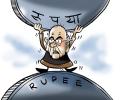
For the first eight months of the current financial year, the figure stood at Rs 7.17 trillion.
Revenue Secretary Sunil Mitra admits tax collection target for 2011-12 is ambitious but achievable.

'India has the potential to do a lot more to take advantage of the time today where we stand to gain, geopolitically and in terms of market attractiveness.'

Finance Minister Nirmala Sitharaman on Monday ruled out a cut in excise duty on petrol and diesel to ease prices, which have touched an all-time high, saying payments in lieu of past subsidised fuel pose limitations. Petrol and diesel as well as cooking gas and kerosene were sold at subsidised rates during the previous Congress-led UPA government. Instead of paying for the subsidy to bring parity between the artificially suppressed retail selling price and the cost that had soared because of international rates crossing $100 per barrel, the then government issued oil bonds totalling Rs 1.34 lakh crore to the state-fuel retailers. These oil bonds and the interest thereon are being paid now.

Data released earlier by CAG shows capital expenditure by the Centre had contracted 9.2 per cent in Q2

Consumption of petrol and diesel will contribute more than half of the Centre's exclusive share in GST in FY20, reports Abhishek Waghmare

Budget has already bombed at the box office and passing it without a revisit will be a mockery of the exercise though any modification may be short lived and perfunctory, observes V Ranganathan.
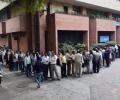
The CAG audit may look into expenditure on printing of notes, RBI dividend payout and banking transaction data.

'This resilience should be viewed as reflecting the strength of the structural story.'

Cash flow-based analysis should throw up businesses better able to survive the transient effects of a working capital crunch, says Devangshu Datta.

This will violate the time-honoured convention that a government elected for a five-year tenure presents only five full Budgets, but the NDA government will no doubt present it as yet another initiative of Mr Modi.

Finance secretary Ajay Bhushan Pandey on Sunday hinted that the government was working on another stimulus package but he refrained from giving a timeframe.

In fact, no other recent Union Budget has held so much significance for the Indian economy as the one to be presented in about six weeks from now, notes A K Bhattacharya.
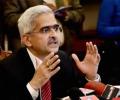
Experts disagree with the idea and the Reserve Bank of India (RBI), which has the sole right to print money, is not comfortable with it as well.

The 14th Finance Commission had recommended that states' share in the divisible tax pool be raised to 42 per cent, from 32 per cent earlier.

If you looked back at 2018 and had to give it a name, the Year of Limitations might be the most accurate.
